


Success Stories
"Rachel"
Patient Profile & Background Rachel is a 45-year-old female with a complex medical and mental health history. Prior to a prolonged hospital admission resulting from right Middle Cerebral Artery (MCA) and Anterior Cerebral Artery (ACA) infarcts, she had moved in with her mother due to mental health challenges. She was subsequently transferred to Neu Living for comprehensive assessment and ongoing rehabilitation.
Initial Clinical Presentation Upon admission to Neu Living, Rachel presented with the following:
Mobility & Motor Function: Left hemiplegia with foot drop (managed via an NHS-provided orthosis) and significant left upper limb weakness. She required a Rotunda/Return stand aid for transfers, ambulated with a quad stick, and presented with a wide-based, step-to gait pattern.
Tone & Cognition: Increased tone in the left upper limb (flexor pattern; MAS 1 to left wrist/finger flexors). While she presented with some cognitive impairment, she could follow commands and engaged positively with therapy.
Rehabilitation Strategy & Interventions The clinical focus centered on achieving independent indoor and outdoor mobility, stair negotiation, and the long-term restoration of upper limb function for Activities of Daily Living (ADLs). Her multidisciplinary treatment plan included:
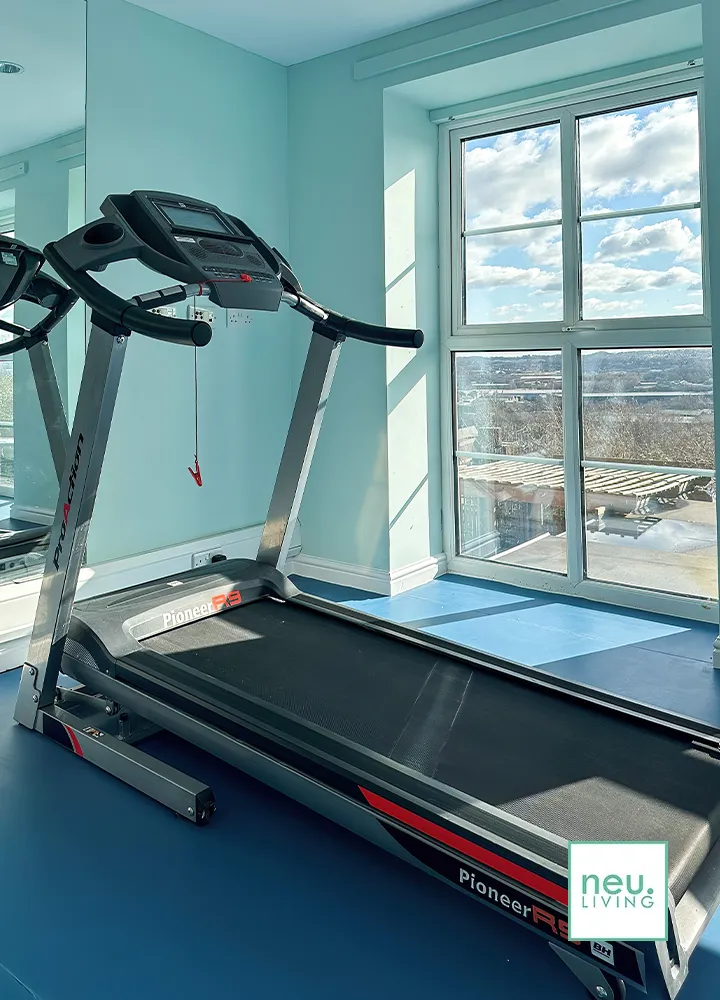
Mobility & Strength: 1:1 physiotherapy featuring gait training (with and without external cues/aids), cardiovascular treadmill training, targeted strength exercises, balance training, and stair practice.
Upper Limb Management: Sensory rehabilitation, functional tasks (e.g., reach-to-grasp), motor imagery, and weight-bearing exercises to manage tone.
4-Week Clinical Outcomes Rachel demonstrated excellent engagement and built a strong therapeutic rapport with staff, significantly increasing her confidence and exercise tolerance.
Mobility (Significant Progress): She achieved notable improvements in functional mobility, transitioning from a 21-second 10-meter walk using a quad stick to a 19-second unaided walk. Her 5-repetition sit-to-stand time also improved from 18 seconds to 14 seconds.
Upper Limb (Expected Plateau): As anticipated due to the severity of the infarcts, upper limb recovery has been slower. However, she achieved marginal improvements in wrist and finger extension strength (progressing from 0/5 to 1/5).
Future Plan & Prognosis Rachel remains highly motivated. Future interventions will focus on:
Continuing gait re-education to safely reduce reliance on balance aids.
Exploring supported outdoor mobility and wider community access.
Considering referrals for Functional Electrical Stimulation (FES) for both gait support (NGH Clinic) and upper limb extensor activity.
Long-Term Objective: To support Rachel's discharge to a semi-independent living arrangement near her family.
Read the full story by CLICKING HERE
"Sarah"
Admitting Diagnosis: Toxic Encephalopathy
Prior Living Situation: Independent
Long-term Goal: Return to semi-independent living
Clinical Presentation
Sarah was transferred to Neu Living for ongoing assessment and rehabilitation following a prolonged hospitalization for toxic encephalopathy. Upon admission, her physical and cognitive baseline presented several challenges:
Cognitive & Neurological: Mild cognitive impairment (though able to follow commands and engage well) and choreiform (involuntary) movements affecting all four limbs.
Mobility & Strength: Generalized weakness, bilateral foot drop, and a wide-based, shuffling gait. She required a walking frame and physical assistance to ambulate.
Rehabilitation Strategy
A targeted rehabilitation program was designed to restore Sarah’s independence in mobility and daily living activities (ADLs).
Mobility Training: Intensive 1:1 physiotherapy focusing on gait correction using visual cues (mini hurdles, targeted stepping) to improve stride length and reduce her base of support. This was supplemented with cardiovascular work, progressive resistance training, and balance/stair negotiation practice.
Upper Limb Function: Dexterity and strength exercises were integrated into functional, task-specific activities, such as cooking and baking in the therapy kitchen.
Clinical Outcomes (4-Week Review)
Sarah demonstrated high motivation and positive engagement with her therapy, resulting in notable, measurable functional improvements within four weeks. Clinical consensus suggests these functional gains are primarily due to adaptive and compensatory improvements rather than direct central nervous system recovery.
Key Metric Changes:
10-Meter Walk: Improved from 21 seconds to 13 seconds.
5-Rep Sit-to-Stand: Improved significantly from 28 seconds to 14 seconds.
Note on static metrics: Her SARA Ataxia Score (23.5 to 21) and Berg Balance Scale (30/56 to 29/56) showed minimal change. However, clinicians note these specific assessment tools may not accurately capture the functional improvements observed in her specific presentation.
Future Care Plan
Sarah will continue a program of graded functional activities to build on her momentum. Next steps involve:
Combining mobility and ADL goals (e.g., assisted walking to the therapy kitchen for meal preparation).
Exploring supported outdoor mobility and community access.
Trialing new mobility aids and ankle orthotics to provide additional support for her bilateral foot drop.